-
Visit

 No:2
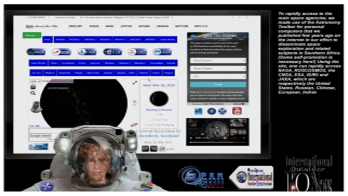
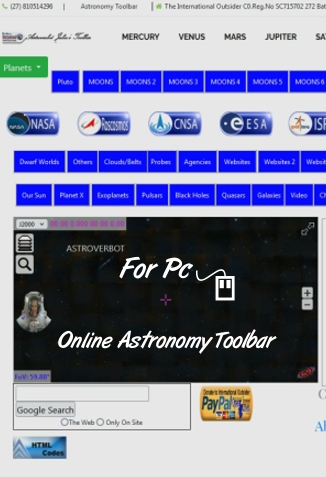
To rapidly access to the main space agencies, we made use of the Astronomy Toolbar for personal computers that we published few years ago on the internet in our effort to disseminate space exploration and related subjects in Southern Africa. (Some self-promotion is necessary here!) Using the site, one can rapidly access NASA, ROSCOSMOS, the CNSA, ESA, ISRO and JAXA, which are respectively the United States, Russian, Chinese, European, Indian and Japanese space agencies. The three best sites according to us are those of NASA, ISRO and ESA in the order that only personal taste will dictate, we acknowledge that our judgment is unfair to the Chinese Space Agency (CNSA) whose website is a festival of images and information. These websites are rich in visual imagery, are interactive and contain far less boring pictures of official and politicians in suits, which plague the whole AFSA site. Can the public relation department of the African agency understand that there should be an awful lot regarding space on a space agency website? It would be a healthier approach rather than forcing the public to ingest pictures of seemingly interested well-dressed people, most probably more concerned by the cocktail following the venue. In other terms yes we want to see suits not Giorgo Armani Fashionable tailor made ones but good old fashion space suits. An example that could be useful to the PR of AFSA; to call for the ESA Graduate Trainee Program, and to attract the youth in general the European Space Agency uses imagery focusing on the instrumentation and environment where the space cadet will evolve, they use panoply of cosmic images which triggers dream and wonder.
Granted, it is undeniably marketing tricks, but it is also images that appeals to the space enthusiast, to the artist, and to the public. Pictures inviting to dream, a stark contrast with the AFSA youth related picture which conveys more to an invitation to a night club. AFSA’s website however stands its ground, rating being a better site than Roscosmos or Jaxa. (We based our opinion in this case more on the visual rather than the content) All in all, it is not that bad for a very young site, it remains that there is still much more to be done.
Before speaking about hard core space technology and programs, let us spend some time on what the vexing issue of the logo was. While assessing the website we discovered that the African Space Agency had done exactly what we proposed in 2023. A competition was organized open to all the creative youth of Africa aged from 18 to 29. Did the Agency get somehow inspired by our article? Certainly not as this kind of incentive should be automatically envisaged by any public relation officer without provoking a cerebral stroke.  We learned that there were 143 candidates for 113 unique participations covering 19 African countries and that the winner of the competition was the 22 years old Cameroonian Remy Fadhil Bouelet. Stop a minute! Let’s rewind that, should we? 113 participations covering 19 African countries! Meaning an average of 5.4 participants per country! More concerning, the contest failed to represent even half of the countries of the continent! What kind of public relations effort has been done to inform those concerned about this competition and the general African public as a whole? Has the memo been properly circulated among the science and education ministries of the member states? If everything has been done to disseminate the information, the then result of 113 participations is a deplorable one and does not give us a lot of hope about the interest of the African youth in space, an idea that we will certainly not adhere to, otherwise we would not have engaged in the business of promoting this sector. Considering the number of schools and institutions dispersed on the continent, taking into account the numerous astronomy clubs,
 amateur rocket enthusiasts existing in the Republic of South Africa alone, this makes such a situation risible on a continent inhabited by one billion souls! As a matter of a fact, why was the competition so restricted in the age range of the participants? Why not a section opened to younger participants? If one of AFSA’s aims is to attract the youth, then they might be interested to know that generally the passion of a space cadet arises at a very young age, most space agencies understand that and teenagers are often targeted by them as proven by the many campaigns aimed at the youth. One can legitimately ask the question, what part of the budget allocated to the competition was spent on the jury meetings to legitimately deliberate about the winner? How much money was spent on the trip of the winner from Cameroon to Cairo? Finally, what was the cost of the award-winning ceremony itself? All those expenditures should then be compared to the amount of money spent on promoting the competition itself and the results should be telling.
What about the logo itself? Is it possible that the insignificant number of participants is only the reflection of the outstanding quality of the submissions?

Mr. Bouelet the winner of the competition is another young beautiful person, reading about his biography we learn that the 22-year-old man holds a degree in software engineering, that he is a passionate graphic designer and that the young man is blessed with the ability to transform ideas into visually stunning experiences. And if that was not sufficiently impressive, the man is said to have a keen eye for detail and is driven by his love of creativity. The Cameroonian national specializes in branding, digital illustration and web design. The bio continues decrypting the winner of the competition as someone who believes that design should inspire and connect and that he embraces challenges as opportunities for innovation. Furthermore we are told that the young African work illustrates an artistic flair and a deep understanding of the audience needs. Finally Mr. Bouelet makes of each project a unique narrative as he strives to leave a lasting impact in the design world. The public is also gracefully informed that the Agency has presented him an award for his outstanding design contribution. Wow! Let’s say straight when anyone waxes lyrical at this level of intensity, it can only mean one of two things. First you really got the real deal and you are very proud to announce it and parade it to the world or two, you are desperate to make everyone think that you are indeed in possession of the true stuff! Because let’s be real and now we want to insist that this work is an article of opinion and our appreciation of the logo must also be taken as such.
The logo is nice  without being special and fails in some respects to deliver the message. First the African continent will not necessarily be taken for the letter F (As it is intended to be as per the design of the logo) by an unaware public making uncertain that people will get this subtle touch at all and ultimately properly read the acronym. A tiny rocket is supposed to illustrate the connection of the logo to space, an intention which it does not necessarily achieve in an era where so many fast food delivery services sport a rocket of some kind. It is also unclear to us what are the ripples at the base of the logo, one could hope that these intent to represent gravitational waves thus connecting the radio astronomical assets of the continent but somehow we doubt it. Someone at AFSA foresaw the problems working with an acronym so widely in use. This person decided to contravene the potential issues by writing the acronym AfSA in upper case except for the letter f. This was actually a correct approach and it seems that it is the policy adopted by the agency. Despite his so called ‘keen eye’ Mr. Bouelet completely missed that detail.
 Including the full written acronym on the logo would facilitate the identification of the agency and eliminate confusion between the other AFSA’s on the market. When in 2023 we published our article on the African Agency, we asked our designer to rapidly put together a logo in the aim of illustrating our arguments. Like Mr. Bouelet, he too thinks that a logo should carry a powerful narrative, his was, a pyramidal structure connecting the ancient Egyptian mythology to the agency, He included the full name of the agency as well as its favored acronym. The connection to space is further emphasized by the triangular shape dear to many space agencies, as appearing recurrently on their logo, even used in TV shows like Star Trek.
 Of course one does not have to follow the trend but sometimes it helps in avoiding confusion. And no! Without ignoring the talent of Mr. Bouelet, we do not see there a deep understanding of the audience needs and even less a visually stunning experience. Once again, it is only our own opinion and those of the few people to whom we exposed the situation. Let’s be one and foremost very clear that our aim is not sensationalism and we would have been very mean if our intention was to disgrace a young man whose guilt was only to participate and win a competition. But would have it not been more modest and closer to the truth to imply that Mr. Bouelet is a talented young man, thank him for participating, praise his efforts and wish that his example would be followed by legions more. Instead we got exaggerated and inflated praises, as if the young man was able to produce a logo of the level of Coca-Cola or NASA every morning before breakfast! The question is who authorized such a bombastic bio to be published on the site , was it provided by Mr. Bouelet or has it been written by the PR of the agency? We think we have the answer to this question and we will come back on that in the conclusion of this article. But at least we got a logo which is better than not having one at all. Let’s hope that as a web designer and a content creator Mr. Bouelet would not have left before giving some much needed professional advice to the I.T team of AFSA.
The title of this article speaks about a Moon Lander, was it click bait? Those who are already used to these pages know that we do not engage in these kinds of activities. Originally, our intention was to build a road map for the construction of an African space probe involving a wide range of cooperation across Africa. Knowing that AFSA would not raise the financing, we thought about proposing the initiation of a task force consisting of African Research Institutes and Universities. AFSA though initiating the project, could maintain strictly a consultative role in the venture. However the African agency would use its weight to liaise with the other space powers and find the ideal international partners. If money was the only hurdle, we intended to prove that the cost could be so radically brought down that it would drain minimal resources from the countries participating in the project. After assessing AFSA’s website we concluded that there were more immediate issues, but we definitively will tackle such a project in the near future.
A few years ago when we wrote about AFSA and its commitments; we argued that promoting outer space projects and programs was in no way contradictory to AFSA’s charter. We even made it clear that it would be in the interest of AFSA to  intentionally provoke (Subtly or not) member states to engage in more ambitious programs. We spoke about space mining, lunar exploration and exploitation. Then as today, we passionately believe that Africa has a brilliant future in space and that a little bit of imagination would make us shine on the international level as well as positioning ourselves on the new wave of space exploitation. Unfortunately, there is no sign of the will to invest or promote lunar or outer solar system exploration on the website of AFSA. There is so to say, no place for dreams and even less for bold undertakings.
It is not as if the website is blend of programs, for example, we are invited to understand the importance of Earth Observation and grasp its critical role in managing resources and preventing disasters. A very interesting example is given decrypting how satellite surveys have predicted locust breeding grounds thus allowing the authorities to take preventive action to save critical farmlands. Other examples including mapping, identification of water and oil drilling spots, deforestation tracking, pollution and environmental damage control etc are given. The user is also asked to consider the efforts of AFSA promoting and implementing navigation and positioning systems to ensure human safety and enhance road, air and sea travel security. There is not a lot to say here, except that these achievements, plans and programs are noble and amenable, however those undertakings are a must, something that has to be done whether we like it or not. To quote the words of Dr Tidiane Ouattara, President of the Council of the African Space Agency (AFSA), “Space is no longer a luxury, it is a necessity.” In the course of his intervention at the “Salon Internationale de l’intelligence artificielle” on the 20th February 2025, Dr Ouattara  said that Africa will no longer be a consumer of space technologies and that the continent ‘must’ become a producer. He is absolutely right but there is nothing here to beat our chest for, those are things that are only obvious undertakings that we should not leave others to do for us…” On That Day, Dr Ouattara was echoing the same words spoken by the Indian Prime Minister Modi a few years ago. The contrast is the vigor with which India approaches the space industry compared to the baby steps of Africa. Dr Ouattara is himself a professional who holds a master’s degree in physical geography and a PHD in remote sensing and geographical information system. Dr Ouattara has an impressive career and served as an advisor to the president of the Canadian space agency but his main focus was earth observation, navigation and positioning, does that explain why the agency seems to be concentrated about promoting the development of these technologies?






 by


It is incredible that there was only such a weak number of participation for this competition. One must really wonder what happened there...
I wonder If the African Space Agency wants to unify African space ambitions or in fact they want to take credit of acheievements of others!